La Croix Energy Capital | Petroleum Derivative Trading

“Think like a fundamentalist; trade like a chartist.”
Dennis Gartman. Rule #8 - Gartman’s Simple Rules of Trading

Thursday, April 15, 2010

EIA Weekly NatGas Storage Report 9-Apr-10

NYMEX Natural Gas 60-min. Intra-day Price Profile
EIA Summary
Working gas in storage was 1,756 Bcf as of Friday, April 9, 2010, according to EIA estimates. This represents a net increase of 87 Bcf from the previous week. Stocks were 64 Bcf higher than last year at this time and 246 Bcf above the 5-year average of 1,510 Bcf. In the East Region, stocks were 126 Bcf above the 5-year average following net injections of 45 Bcf. Stocks in the Producing Region were 55 Bcf above the 5-year average of 610 Bcf after a net injection of 38 Bcf. Stocks in the West Region were 65 Bcf above the 5-year average after a net addition of 4 Bcf. At 1,756 Bcf, total working gas is above the 5-year historical range.

Source: U.S. Energy Information Administration; NOAA

Wednesday, April 14, 2010

Derivatives Trading in the News

Banks Would Be Forced to Push Out Derivative Trading Under Plan
April 15 (Bloomberg) -- Goldman Sachs Group Inc., JPMorgan Chase & Co. and their biggest rivals would be forced to wall off derivatives trading operations from their commercial banks under a measure to be introduced by Senate Agriculture Committee Chairman Blanche Lincoln, a congressional aide said.

Lincoln, an Arkansas Democrat, will propose a “no-bailout provision” as part of an overhaul of derivatives regulation she plans to unveil today, according to the aide, who declined to be identified because the plan isn’t public. The measure aims to ensure banks don’t endanger depositors’ money with risky trading of over-the-counter derivatives, the aide said.

OPEC Monthly Oil Market Report 14-Apr-10

The world economy continues to improve and is now expected to grow by 3.5% in 2010. The OECD is forecast to grow by 1.9% in 2010 compared to the previous forecast of 1.7%. The US is expected to contribute the most within the OECD with growth of 2.6%. Japan is forecast to grow by 1.5% and the Euro-zone by 0.7%. China and India are forecast to contribute significantly to global growth expanding at 9.5% and 7.1% respectively. Challenges to this benign outlook include concerns about the level of public debt in many OECD countries, continued high unemployment levels and the risk of a correction in China if government efforts to avoid overheating misfire.

World oil demand is estimated to have contracted by 1.4 mb/d in 2009, broadly unchanged from the previous report. In 2010, global consumption is projected to increase by 0.9 mb/d, in line with the previous forecast. Economic activities in the US are playing the wild card for the world oil demand growth. All the expected growth in oil demand this year is projected to come from the non-OECD region led by Asia. Overall, most growth will come from transport and petrochemical sectors worldwide.

Read more: http://www.opec.org/opec_web/static_files_project/media/downloads/publications/MR042010.pdf
Source: OPEC

EIA Weekly Petroleum Status Report 9-Apr-10

NYMEX Crude Oil 60-min. Intra-day Price Profile
Stocks mmbbls
Crude: 354.0 (-2.2)
- Cushing: 32.3 (+1.1)
Gasoline: 221.3 (-1.0)
Distillates: 146.8 (+1.1)
Total Products: 695.3 (+1.9)

Supplied mmbbls/d
Gasoline: 9.3 (+0.2)
Distillates: 3.6 (-0.1)
Total Products: 19.0 (+0.1)

Refinery Utilization: 85.59% (+1.1)
Source: U.S. Energy Information Administration

Tuesday, April 13, 2010

API Stocks 9-Apr-10

mmbbls
Crude: +1.4 (vs. +1.5 fcst)
Gasoline: +1.6 (vs. -0.6)
Distillates: +1.7 (vs. +0.9 fcst)

NEW YORK, April 13 (Reuters) - U.S. crude oil futures dipped some more in post-settlement trading on Tuesday after industry data showed that U.S. crude stocks rose last week.

Gasoline futures fell back to near flat as data from the American Petroleum Institute showed gasoline supplies increased, defying forecasts for a decline.

Heating oil futures extended losses on API's report of a larger-than-expected stock build.

The gasoline build was "bearish relative to both expectations for a draw and the five-year average drop of 1.8 million barrels," said Tim Evans, analyst at Citi Futures Perspective.

Options in the News

Options Show S&P 500 Profit Shortage Amid Stock GainsApril 12 (Bloomberg) -- The biggest rally in seven decades has left investors so skittish that even forecasts for a 30 percent surge in U.S. earnings are failing to keep them from hedging bets on equities.

The premium on options that insure against losses in the Standard & Poor’s 500 Index over those wagering on gains, known as skew, rose to the highest level since June 2008, data compiled by Bloomberg show. Traders sought protection as shares rallied for six weeks, pushing a measure of momentum that compares stocks with their 50-day average to the most bearish reading in 13 months, according to Bespoke Investment Group LLC.

While forecasts for the fastest profit growth in 16 years restored $6.63 trillion to U.S. equities since March 2009, the worst times to own stocks were when companies reported quarterly results. The S&P 500 dropped more than 5 percent after earnings season began in October and January, rebounding after better- than-estimated income held valuations below historical averages.

IEA Oil Market Report 13-Apr-10

Global oil demand is revised down by 70 kb/d in 2009 and up by 30 kb/d in 2010 on preliminary data adjustments in the OECD and non-OECD (Asia, Africa and Middle East). With demand now seen at 84.9 mb/d in 2009 and 86.6 mb/d in 2010, year-on-year growth averages -1.3 mb/d and +1.7 mb/d, respectively.

Global oil supply fell by 220 kb/d to 86.6 mb/d in March on lower OPEC output. Non-OPEC supply was unchanged in March at 52.5 mb/d, and up by 900 kb/d year-on-year. Non-OPEC 2010 output is revised up 220 kb/d to 52.0 mb/d, reaffirming a more optimistic supply outlook amid elevated price levels since 2Q09. Non-OPEC supply and OPEC NGLs should rise by a combined 1.3 mb/d in 2010.

OECD industry stocks fell by 38.4 mb to 2 685 mb in February, 1.6% below 2009’s level, with lower crude, distillates and ‘other products’. End-February forward demand cover rose to 60.0 days, but stood 0.9 days below levels of a year ago. Preliminary March data point to a 8.0 mb OECD stock build amid continued decline in floating storage.

Saturday, April 10, 2010

Energy in the News

Solving the mystery of rising oil prices

Apr-5 (Financial Post) Here's a mystery for you. The price of oil has more than doubled over the past 15 months. It rose during the darkest days of the recession and Monday continued its seemingly inevitable climb to US$90 a barrel. But why?

Despite a recovering global economy, oil consumption is growing only slowly. Inventories are generous. The futures market is signalling that supply will be ample during the next few years.

So why should the price of oil be surging? The most likely explanation is that oil is no longer simply that stuff that fuels our cars and heats our homes. It's become a financial asset. And that has implications, not only for energy investors, but for the loonie as well.

Read more: http://www.financialpost.com/news-sectors/energy/story.html?id=2765810#ixzz0ki6i5UTL

Friday, April 9, 2010

Market Review Week Ending 9-Apr-10

S&P500
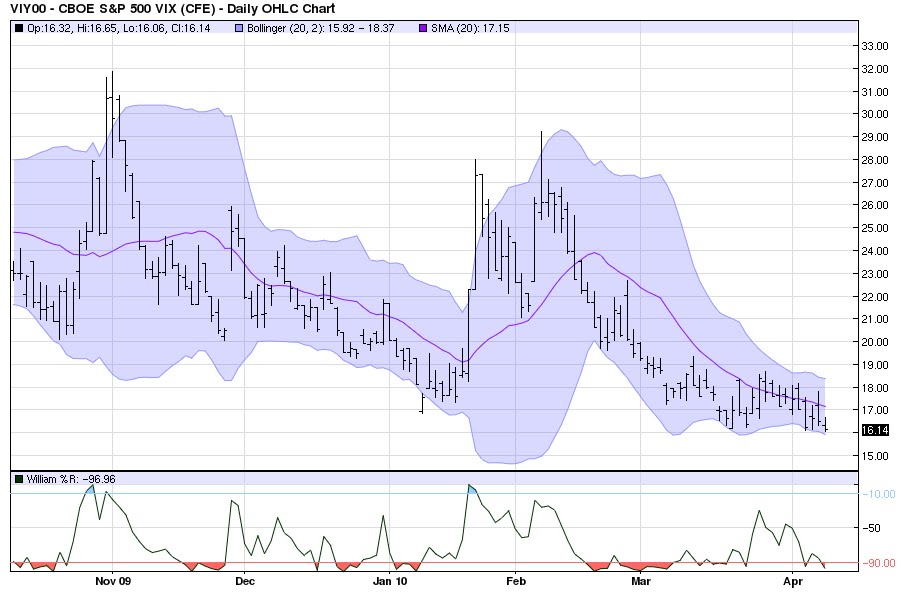
CBOE VIX
USDX
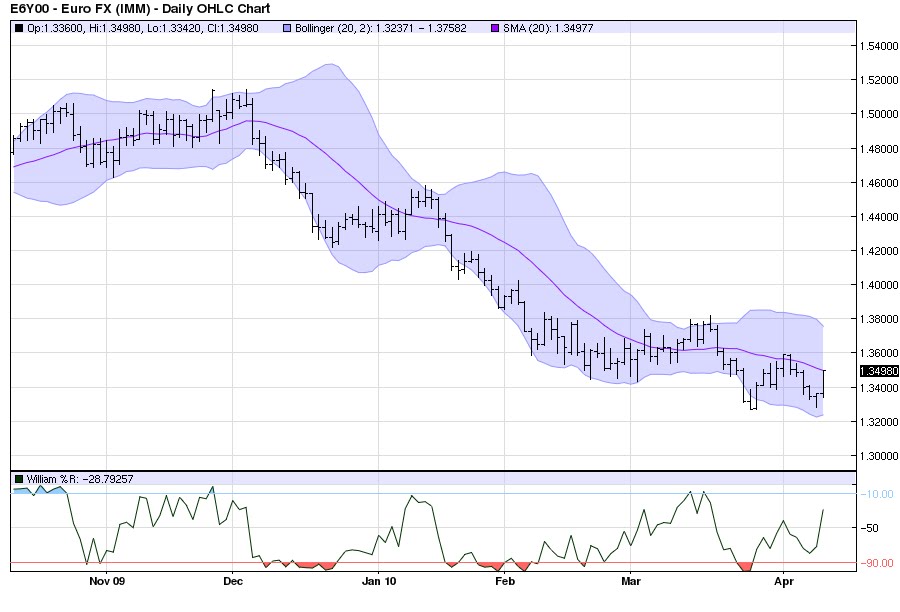
EURO
CAD
NYMEX Crude Oil Daily Continuation
NYMEX Crude Oil Weekly Continuation
NYMEX Natural Gas Daily Continuation
NYMEX Natural Gas Weekly Continuation

CFTC Commitment of Traders 6-Apr-10

Source: U.S. Commodity Futures Trading Commission

Baker Hughes N.A. Rotary Rig Count 9-Apr-10

Source: Baker Hughes, Inc.

Thursday, April 8, 2010

EIA Weekly NatGas Storage Report 2-Apr-10

NYMEX Natural Gas 60-min. Intra-day Price Profile
EIA Summary
"Working gas in storage was 1,669 Bcf as of Friday, April 2, 2010, according to EIA estimates. This represents a net increase of 31 Bcf from the previous week. Stocks were 2 Bcf less than last year at this time and 180 Bcf above the 5-year average of 1,489 Bcf. In the East Region, stocks were 87 Bcf above the 5-year average following net withdrawals of 3 Bcf. Stocks in the Producing Region were 28 Bcf above the 5-year average of 599 Bcf after a net injection of 31 Bcf. Stocks in the West Region were 65 Bcf above the 5-year average after a net addition of 3 Bcf. At 1,669 Bcf, total working gas is within the 5-year historical range."

Source: U.S. Energy Information Administration; NOAA

Weather in the News

Forecast Team at Colorado State University Predicts Above-Average 2010 Hurricane Season FORT COLLINS - The Colorado State University forecast team predicts an above-average 2010 Atlantic basin hurricane season based on the premise that El Nino conditions will dissipate by this summer and that anomalously warm tropical Atlantic sea surface temperatures will persist.

The team predicts 15 named storms to form in the Atlantic basin between June 1 and Nov. 30 with eight expected to be hurricanes and four developing into major hurricanes (Saffir/Simpson category 3-4-5) with sustained winds of 111 mph or greater.

Long-term averages are 9.6 named storms, 5.9 hurricanes and 2.3 major hurricanes per year.

Wednesday, April 7, 2010

Trading in the News

Startups fuel growth in super-fast trading
Apr-7 (Reuters) - Tumbling technology costs have opened potentially lucrative ultra-fast trading strategies to tiny startup players, fuelling growth of the opaque and controversial business across Europe and the United States.

Backed by private equity, or armed with bonuses earned at banks, traders have been encouraged by an 80 percent or greater fall in the cost of setting up lightning-fast systems over the past five years, trading software provider Portware said.

"The numbers of these firms has exploded," Richard Balarkas, chief executive of broker Instinet Europe, said at the Reuters Global Exchanges and Trading Summit last week.

"I hear venture capitalists are giving money to guys coming straight out of MIT (Massachusetts Institute of Technology) and setting up desks," he said.

In high-frequency trading, firms such as hedge funds use lightning-fast computers to beat other investors to profitable trades, sometimes moving their computers physically next to an exchange to gain an extra advantage. It is a highly secretive world, where the fear to give away trading secrets is omnipresent and there is often no accountability to external investors.

EIA Weekly Petroleum Status Report 2-Apr-10

NYMEX Crude Oil 60-min. Intra-day Price Profile.
Stocks mmbbls
Crude: 356.2 (+2.0)
- Cushing: 31.2 (+0.2)
Gasoline: 222.4 (-2.5)
Distillates: 145.7 (+1.1)
Total Products: 693.4 (+5.2)

Supplied mmbbls/d
Gasoline: 9.1 (unch)
Distillates: 3.6 (unch)
Total Products: 18.9 (-0.1)

Refinery Utilization: 84.49% (+1.89)
Source: U.S. Energy Information Administration

Tuesday, April 6, 2010

EIA Short-Term Energy Outlook

Global Crude Oil and Liquid Fuels
Crude Oil and Liquid Fuels Overview. EIA's assessment of world oil markets is largely unchanged from last month's Outlook, and world oil prices will likely continue to firm and increase slightly in response to the global economic recovery. As long as the global economy continues to recover, and the Organization of the Petroleum Exporting Countries (OPEC) remains satisfied with its constrained supply targets, global oil markets should remain in this situation. Major uncertainties include the pace of global economic recovery and the extent to which the largest economies continue their stimulus and other economic policies.

API Stocks 2-Apr-10

mmbbls
Crude: +1.1 (vs. +1.8 fcst)
Gasoline: -3.0 (vs. -0.8 fcst)
Distillates: +0.8 (vs. -1.2 fcst)

NEW YORK, April 6 (Reuters) - U.S. crude oil futures nursed small gains in post-settlement trade on Tuesday after weekly industry inventory data showed a larger-than-expected gasoline stock decline and smaller-than-forecast crude stock build.

Gasoline futures posted a minor gain after being flat just before release of the American Petroleum Institute's data and after being down slightly at settlement.

The gasoline drawdown was "a bullish surprise relative to consensus expectations for a smaller draw, although we note this outcome would be similar to a 3.1-million barrel five-year average drop," said Tim Evans, energy analyst at Citi Futures Perspective in New York.

Shipping in the News

Tanker Rates Seen Sinking 35% Amid Refinery Cutbacks
April 6 (Bloomberg) -- The most profitable supertanker market in more than a year is heading for a 35 percent slump as oil refineries from Japan to the U.K. shut for maintenance and leave a surplus of vessels.

Shipping costs will fall to an average of $28,758 a day this quarter from $44,576 on April 1, according to the median estimate in a Bloomberg survey of 13 analysts, traders and shipbrokers. Rates to hire the ships, each bigger than the Chrysler Building, averaged $49,908 a day in the first quarter, the most since the last three months of 2008.

Read more: http://www.bloomberg.com/apps/news?pid=newsarchive&sid=aoq5M717QO0c

Friday, April 2, 2010

CFTC Commitment of Traders 30-Mar-10

Source: U.S. Commodity Futures Trading Commission.